Keynote Speakers

Prof. Kwang-Cheng Chen, University of South Florida and MediaTek Inc.
Biography:
Kwang-Cheng (K.-C.) Chen has been a Professor at the Department of Electrical Engineering, University of South Florida, since 2016, and is taking the sabbatical leave at the MediaTek Inc. Dr. Chen is a member of US National Committee on quantum technologies, and chairing a panel (related to cryptography, cybersecurity, and applied & computational math) for National Academies of Sciences, Engineering, and Medicine. From 1987 to 2016, Dr. Chen worked with SSE, Communications Satellite Corp., IBM Thomas J. Watson Research Center, National Tsing Hua University, HP Labs., and National Taiwan University in mobile communications and networks. He visited TU Delft (1998), Aalborg University (2008), Sungkyunkwan University (2013), and Massachusetts Institute of Technology (2012-2013, 2015-2016). He founded a wireless IC design company in 2001, which was acquired by MediaTek Inc. He has been actively involving in the organization of various IEEE conferences, serving GITC Chair, IEEE Communications Society and editorships with several IEEE journals and Nature Scientific Reports (Section Editor, Quantum Engineering), together with various IEEE volunteer services to the IEEE, Communications Society, Vehicular Technology Society, and Signal Processing Society, such as founding the Technical Committee on Social Networks in the IEEE Communications Society. Dr. Chen also has contributed essential technology to various international standards, namely IEEE 802 wireless LANs, Bluetooth, LTE and LTE-A, and ITU-T FG ML5G. He has authored and co-authored near 400 IEEE publications, 4 books published by Wiley and River (most recently, Artificial Intelligence in Wireless Robotics, 2019), and more than 29 granted US patents. Dr. Chen is an IEEE Fellow and has received a number of awards including 2011 IEEE COMSOC WTC Recognition Award, 2014 IEEE Jack Neubauer Memorial Award, 2014 IEEE COMSOC AP Outstanding Paper Award. Dr. Chen’s current research interests include quantum communications and computing, wireless networks, post-quantum cryptography, multi-robot systems, and social networks.
Title:
Wireless Robotic Communications – 6G Integrated Communication and Computing
Day/Date/Hour/Venue:
Monday/10 November 2025/09:15-10:00/Main Conference Hall
Abstract:
Embodied AI, reasoning, and vision-language-action models transform robotics to a new territory of artificial intelligence. Humanoids, self-driving cars, and even humans with XR technology, can all be viewed as robots. To make multiple robots working more efficiently, we demonstrate that wireless robotic communications enhance AI computing, particularly under partially observable operating conditions. From a series of computational experiments, we explore the unique traffic patterns of wireless robotic communications, communication and networking architecture of wireless robotic communications, proper information exchange of wireless robotic communications enhancing the performance of robots. All the outcomes suggest a new technological frontier of integrated communication and computing (ICC) toward 6G vertical systems. When user equipment of significant AI computing capability, wireless (robotic) communications and networking among smart user equipment paves technology avenue toward 6G mobile communications.

Dr. Uma S. Jha, Sr. Director, National Semiconductor Technology Center (NSTC), USA
Biography:
Dr. Uma S. Jha is a Senior Director at Terran Orbital, a Lockheed Martin Company. Prior to this he was Sr. Fellow at L3 Harris Technologies. He is internationally known for his AI, Quantum, Autonomy, Microelectronics, and RF Communication expertise and capabilities. He has also served as Technical Fellow at Raytheon & Boeing, Director at Qualcomm as well as high profile start-ups in various executive roles. Dr. Jha has 30 patents in the consumer electronics domain and actively participates at industry consortia, standards fora, and academia as a keynote speaker, panelist, and advisor. He has published more than 40 papers and is the primary author of a book on next generation broadband communication systems. He is a Fellow of IEEE and AI IA Fellow and serves on Technical Program Committee (TPC) for IEEE and International conferences. He has organized an international conference, WPMC 2006, as the General Chair where more than 600 people participated from 43 countries. Dr. Jha received a joint Ph.D. from University of Southern California, Los Angeles, California and Aalborg University, Denmark, a MSEE from California State University, and BSEE from BIT Sindri. Additionally he received an Engineering Management certification from California Institute of Technology, USA.
Title:
CubeSat – The Next Frontier in Space Superiority
Day/Date/Hour/Venue:
Monday/10 November 2025/10:00-10:45/Main Conference Hall
Abstract:
As space becomes an increasingly contested and congested domain, the need for agile, cost effective, and scalable technologies has never been greater. CubeSats – miniaturized satellites built in standardized units – are revolutionizing the way nations and organizations approach space operations. Once relegated to academic experiments, CubeSats now play a pivotal role in defence, surveillance, communication, and scientific exploration.
This talk explores how CubeSats are reshaping the strategic landscape of space superiority. We delve into their rapid deployment capabilities, swarm intelligence potential, and integration with AI and edge computing. From enhancing situational awareness to enabling resilient space architectures, CubeSats offer unmatched versatility in low Earth orbit and beyond.
Attendees will gain insights into current advancements, emerging threats, and the geopolitical implications of CubeSat proliferation. The session will also highlight key challenges – such as orbital debris, cybersecurity, and spectrum management – and propose frameworks for responsible innovation in this dynamic frontier.

Dr. Markus Dillinger, R&D head for 5GV2X, Munich Research Center Huawei Technologies, Germany
Biography:
Markus Dillinger received his Diplom-Ing. degree in telecommunications in 1990. In 1991, he joined the Mobile Network Division at Siemens for the development of cellular base stations. At Siemens times he led European research projects for mobile communications. In 2010, he joined Huawei Germany and was director for enterprise solutions for several sectors. In September 2016, he was appointed as Executive Committee member for the 5GAA and re-assigned in following years. These 3 Executive Committee members are responsible for the 5GAA operation. He was the initiator of 5GAA and leads the Munich team for their technical contributions to Working Groups in 3GPP / 5GAA and for 5G evolution and to 6G.
Title:
Security and Trust in 6G Era
Day/Date/Hour/Venue:
Tuesday/11 November 2025/09:15-10:00/Main Conference Hall
Abstract:
The talk will evaluate different approaches of different studies and proposals for trust and security integration in 6G. The challenges for Native AI in 6G networks will play a pivotal role and the pillars for trust and trust worthiness need to agreed upon in a broad societal consensus before any technical implementation can be standardized. Significant research gaps remain to be addressed to answer many questions: How to design a trust framework for 6G? How to provide trustworthy autonomous network operations with embedded intelligence ? How do we integrate diverse components into a trustworthy 6G ecosystem?
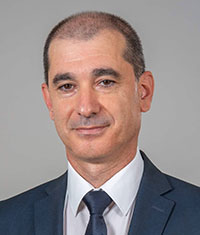
Prof. Sotir Sotirov, Burgas State University, Bulgaria
Biography:
Prof. Sotir Sotirov is the Head of the Laboratory of Intelligent Systems and a leading researcher in the fields of artificial intelligence, computational modeling, and medical image analysis. His scientific interests focus on hybrid and intuitionistic neural networks, fuzzy logic, and intelligent decision-support systems. He has developed original models that integrate intuitionistic fuzzy sets with deep neural architectures for image interpretation and radiogenomics, contributing to the advancement of explainable and trustworthy artificial intelligence in medicine.
Prof. Sotirov is the author and co-author of over 180 scientific publications in IEEE, Springer, and Elsevier journals. He has served as coordinator and leading expert in numerous national and international research projects in the areas of artificial intelligence, cyber-physical systems, and digital educational technologies.
As a Senior Member of IEEE and a recognized academic leader, Prof. Sotirov actively promotes the integration of advanced AI methods into medicine and education. His current research focuses on hybrid neural architectures that leverage the potential of 6G and edge computing for intelligent and reliable real-time medical image analysis.
Title:
Hybrid Neural Networks for Medical Image Understanding in the 6G Era
Day/Date/Hour/Venue:
Tuesday/11 November 2025/10:00-10:45/Main Conference Hall
Abstract:
In the 6G era, hybrid neural networks emerge as a key enabler for intelligent medical image understanding. The proposed model integrates Convolutional Neural Networks (CNNs) with intuitionistic fuzzy logic to ensure reliable diagnosis of pediatric pneumonia from chest X-rays. The architecture extracts localized features from distinct regions and fuses them through logical uncertainty integration, achieving 94.93% accuracy. This approach demonstrates strong potential for deployment
in 6G edge environments, enabling fast and adaptive real-time processing. Future directions include generative AI, multimodal data fusion, and explainable artificial intelligence to support next-generation telemedicine and context-aware healthcare systems.